Attempting to define what the future is without a doubt one of the most complex tasks a person might undertake. Some may say the future is just a time that has not occurred yet. The events which have yet to take place, whether it be 5 seconds from now or 5 years. However, this is an incredibly surface-level perspective of what the future is or might be. Further investigation into the matter may result in an answer that can either make no sense at all or make perfect sense, depending on the individual and the context.
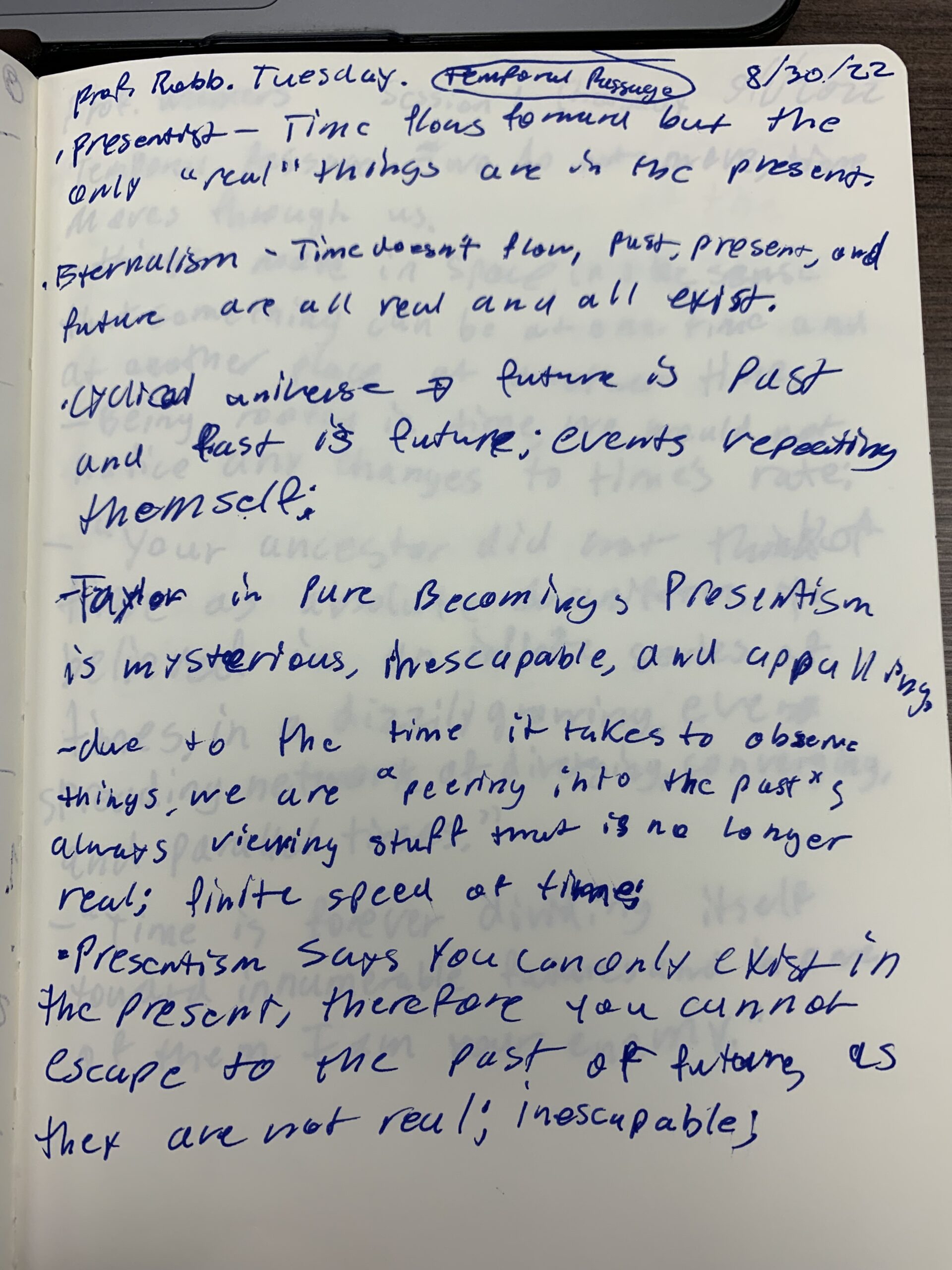
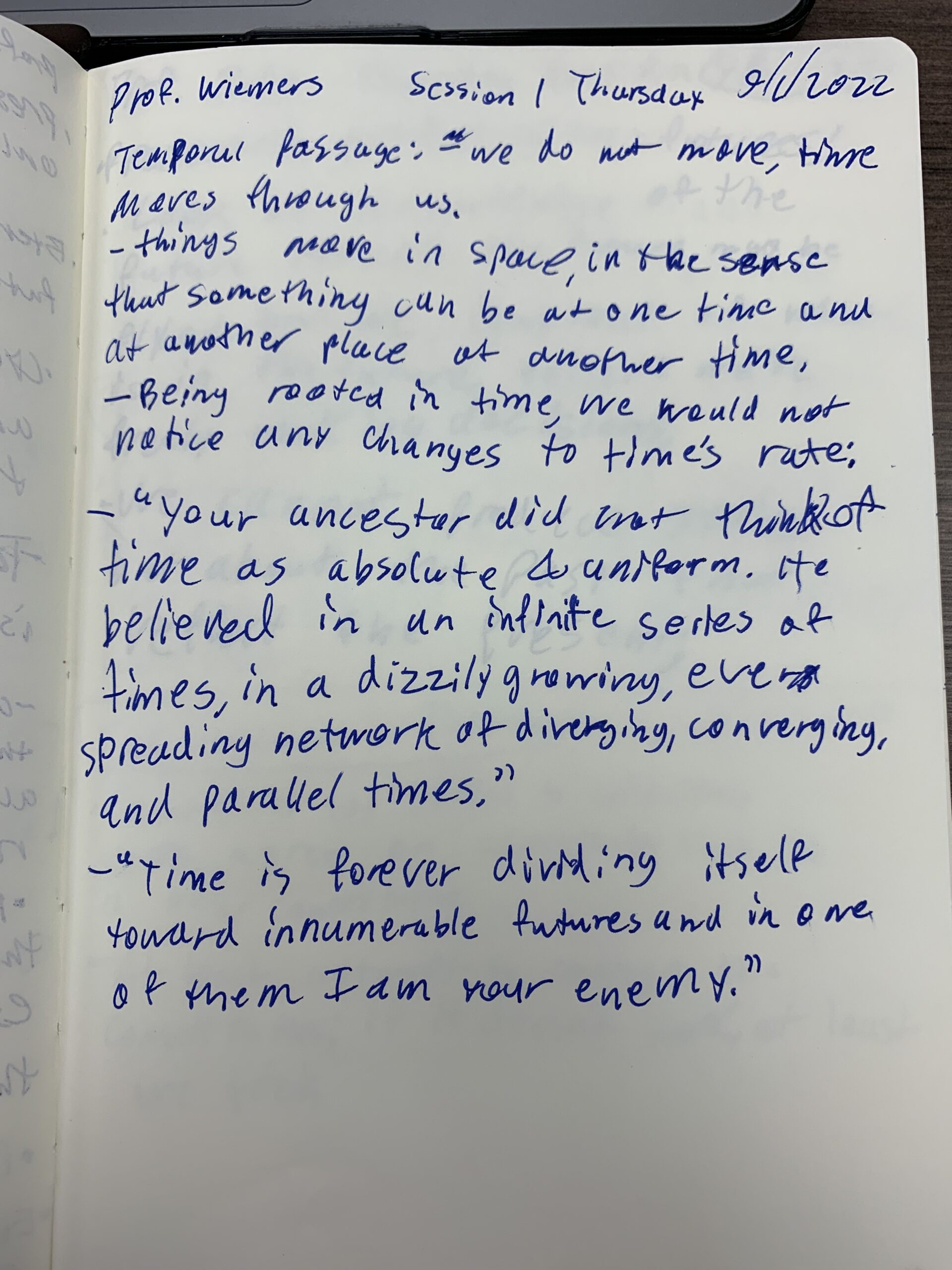
In our first lecture of Humanities-103 within Hance Auditorium, Dr. Robb kindly woke the entire class up to the reality that the future is more difficult to define than any of us could have ever imagined. In both Sapere Aude and this lecture, we discussed two primary trains of thought behind the future, these being Eternalism and Presentism. Eternalists believe that time does not flow in the sense that one day moves to the next, but rather, the past, present, and future are all taking place at the same time. Presentists, however, believe time flows forward, but the only real things are within what we perceive as the present. These two conflicting points of view on the future make it difficult to determine which may or may not be correct, especially as their idea of the future is based on theory. From a personal standpoint, I believe that the present leads to the future somewhat linearly, though the lines may constantly be altered or grafted at some point. The Garden of Forking Paths supports this to a degree, as we discussed the notion that the future has many “paths” that may occur, and each path is dependent on what choices an individual makes within the present. While I do not necessarily see it as a web or a mass of potential futures, I consider there to be a direct connection between the present and how it affects the future.
Given that the future is determined by what happens in the present, the future is therefore controllable, to an extent, by the people in the present. What happens in the present becomes the past as soon as the present proceeds forward, to the future, therefore, the future becomes the past over any measurable unit of time. Instances of this can be seen in the history of any nation on the planet. The future of Rome, though unknown, was to become one of, if not the greatest military forces in the world. However, once they reached their peak, or rather, once their peak was in the present, everything that occurred before this became the past. Another example is seen within scientific developments, which continue progressing, making each development in a certain field “the past” after every new progression. In We3, we read a graphic novel depicting a future in which animals combined with technology are utilized by humans, illustrating what a future may look like depending on what occurs within the present. The choice to use animals in warfare and the choice to pursue cyborg-like scientific developments, though becoming choices made in the past, may potentially lead to a future in which we surgically attach electronics to animals and use them for our own purposes. This reinforces the idea that the future is able to be affected by choices made in the present.
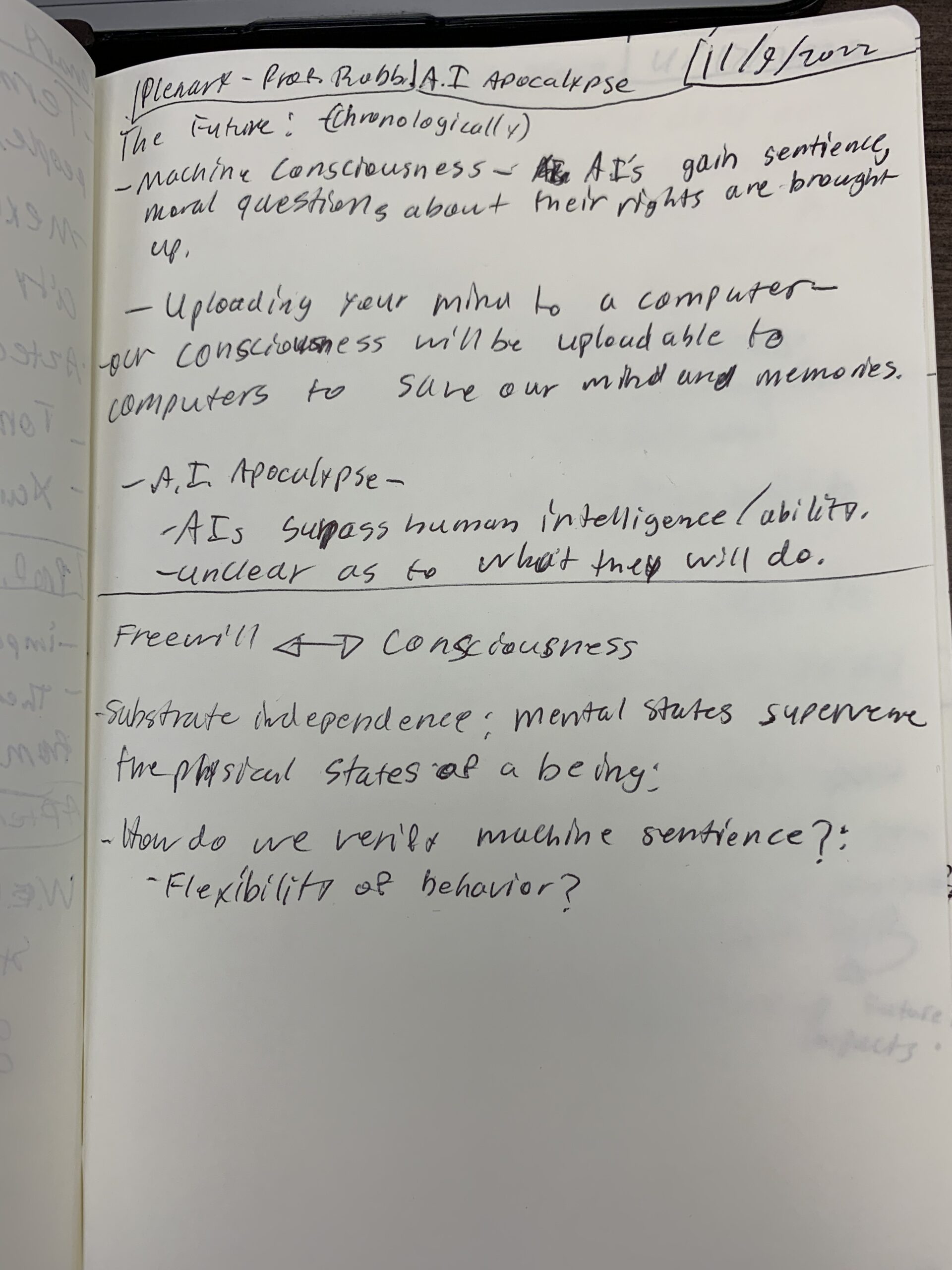
Because the present is coming and going constantly, with every second and minute, and hour that passes becoming the past, the future might then be able to be considered the present. This is because by the time the future occurs and we perceive it, it will already be taking place and then passing. The discussion of AI development with Dr. Robb in Unit 3 exemplifies the idea of the future is now. Artificial intelligence, in its rapidly developing state, is perpetually improving and growing in capability and, well, intelligence. There are “bots” that we can have entire conversations with, who respond as well as a human might. The question for this unit, “who is the future?”, should then be asked while focusing on AI. Is the future going to consist of humans? Will it consist of artificial intelligence? If they are constantly improving and evolving, will they eventually overtake humans and replace us as the dominant being on the earth? Many questions that, at this point in time, have no solid answers. The only thing we can believe with a strong degree of certainty is that the future of AI is always coming and going, just like the present. This is an example of the fluidity of time passing into the future. The future is immaterial but inevitable, determined by the present which becomes the past, allowing the future to become the present, and the cycle continues.
The future is as immaterial as a ghost, though it is an inevitable force that may not be prevented. It will happen and everyone’s future will be different, though it fully depends upon the choices they make in the present to lead them down a future path. These paths continue endlessly, as a whole, but individually, cease at the end of a person’s life. The only thing that seems to impact the future (though not necessarily setting it in stone), seems to be the present. The present fades into the past, however, and the future, determined by the now past, becomes the present. As this cycle continues, it may then be concluded that the future is the present, and the present is the past, and because of this, the past and the future, while not being the same, per se, are different states of being of the same entity, or concept.
Knowing the who, the what, and when of the future is only half the work done, however. Following this paper’s establishment of these aspects of the future, we must now discuss the topic of what the aesthetics and ethics of this future may be, as well as what a potential “end” of the future might consist of.
The first several weeks of Humanities-104 revolved around the subject of what “aesthetics” would be in the future. A major concept that made its appearance was critical fabulation, which is essentially a combination of fiction mixed with genuine history used to a story to those who otherwise would be unable to have theirs told. If not recorded, who will retell the past? Who will inform others of the actions and lives of those who do not have a voice or any other means to? This is undoubtedly a touchy subject, as there are instances of critical fabulation being employed to retell stories of those who may not have wanted theirs told; this practice, while giving a voice to the voiceless, also robs them of their agency and ability to choose to have their life, or a version of it, told. This is where Unit 5 of the Humanities course progression makes its appearance: the Ethics of the Future.
In a future that involves practices such as critical fabulation, ethics are certain to be a necessary topic for discussion. Within Unit 5, the subject of “collective responsibility” was perhaps most notable. Given our establishment that the present and the actions of those in the present determine the future, collective responsibility, to be quite blunt, is what will make or break a positive future. Collective responsibility is simply the work of multiple individuals coming together to achieve a common goal, such as with climate change or social activism. Regardless of what this common goal may be, there will always be some form of collective responsibility upon people, to build up society, to care for later generations, and to ensure a future is present and continues to be possible for them.
With the idea of ensuring a future for our youth and their eventual youth through our collective responsibility, we finally move on to the sixth and final unit of the Humanities course: the Ends of the Future. The topic we discussed that pertained most to what is encompassed by the “future” was what the future’s end would consist of. Whether discussing a fictional world in which a plague was spreading around the world and wiping out the human race or a virus turning them into rage-filled, bloodthirsty beings, it came down to this: an “end of the future” would mean the inability to reproduce, inability to further bloodlines. In the movie 28 Days Later, Major West made this evident when he attempted to, most unethically, keep two of the female characters alive for the sole purpose of using them for reproduction. This was his ulterior motive, as he had promised the presence of women to his men for their efforts, i.e. they would have women to engage in sex with. This also provides a second part of what an end of the future would be caused by: a lack of purpose, a lack of a reason to continue. In the movie, the objectification of women and their bodies is what gave Major West’s men their drive to keep going. Though an incredibly twisted context, it revealed what would bring the future, whether it be our future or the future of those as of yet unborn, to an end: a lack of reproductive means. Being unable to continue the existence of a race, whether due to biological or mental reasons.
And thus, across the six units and two semesters of Humanities, a working definition of the Future is here. The future as established by this definition is something liquid, something without an exact vision. The collective actions of those in the present are what shall determine and shape the people and nations of the future, the technology and aesthetics, and societal rules utilized and followed by them. And finally, the ultimate end of the future will occur when there is no longer a viable method, or reason, to move on and continue living, to continue shaping a later future.