Unit 1: “What is the Future?”
Prompt: “Post a comment or question about the Taylor reading (or our discussion of it on Tuesday) as well as a comment or question about the Borges reading. Aim for a short paragraph for each. Your section professor, who may have more specific instructions, might use some of your posts as the basis for discussion on Thursday morning.”
Response: I found it particularly interesting how Taylor speaks about the flow of time. Everyone experiences time differently, and it is fully dependent on the stimuli affecting them. Perhaps this is the reason why time seems to “pass by” the older we get–we tend to increase the activities in our everyday lives, thereby causing more distractions to our consciousness. Beginning a sport or having fun with friends has no impact on time, but rather has an impact on our observation of it. It’s mildly amusing how “time” is a concept we have developed to keep track of physical changes to objects in space, yet it is a natural force that we still fail to comprehend even in the slightest.
Expansion: Given that this was a post made in the first week of the semester, I would say that my idea of the observation of time passing has been confirmed. As I said in the above response to Taylor, “we tend to increase the activities in our everyday lives, thereby causing more distractions to our consciousness.” My observation of time seems to have sped up since school started, with each week coming to a close in what feels like a shorter period of time than the last; at the same time, class workloads have increased and I have remained busy in almost every waking moment. From my eyes, it is almost as if I blinked in August and opened my eyes in November. However, while others may or may not agree with my notion that time appears to move faster when one is more engaged, the mere fact that this is my observation of it exemplifies how flexible this concept is, and how it can take shape in a different form to everyone.
Unit 2 Moodle Post: Expanded
Unit 2: “Who is the Future?”
Prompt: “What do you think distinguishes “animal” and “human?”
Response: I would say that complex emotion and, in most cases, having a conscience are what distinguishes “animal” from “human”. Animals, while capable of understanding and showing emotions such as affection, grief, anger, etc, are not so reliant on them to make decisions, in my opinion. Instead, instincts tend to be the primary driving force for many animals, while humans generally possess more complex thoughts and emotions, and as a result, act upon these. We have ethics and morals, and the instincts that we usually rely on to determine our decision-making seems to be self-preservation (hunger, thirst, evading danger, etc) and caring for/nurturing our youth.
Expansion: I used human ethics and morals as one of my points in my response to “what distinguishes animal from human”, but did not consider how this might tie into other concepts or areas of study we have looked at this semester, the most prominent being the future. Ethics and morals have been altered and developed throughout history and even prehistory, with societies rising and falling as a result of the standards they held themselves and others to. There is, of course, a hint of irony with regard to the idea of societies rising while possessing “ethics” and “morals”, especially the traditional western ones who participated en masse in colonization. We as humans tend to section ourselves off from being animals due to our supposed morals or ability to function as communities while also improving every aspect of our existence. For hundreds of years, however, horrific acts of violence have been perpetrated by the very nations pushing the idea that they are “civil” and right in colonizing countries. Perhaps the greatest example of this is the continent of Africa, which has known incredible tragedy at the hands of Western European powers and the “ethics” and “morals” they allege to live by. This shows that maybe we are not quite so different from animals as we believe, at least when it comes to the concepts we like to believe we are engrained with.
Unit 3 Moodle Post: Expanded
Unit 3: “When is the Future?”
Prompt: “We’ve encountered several Big Ideas this week: the sublime, hyperobjects, and the anthropocene. Paste a screencap of your current Universal Paperclips game here, and then connect your playing of the game to one of these Big Ideas. How does the game illustrate—or not illustrate!—one of these concepts?”
Response: I would say that this game illustrates the concept of hyperobjects quite well, utilizing paper clips. The game essentially started out as a fun little paperclip-selling game, which I was surprised to be quite enjoyable. However, the more I progressed with the production and selling of these paper clips, the more I really lost the scale of just how many paper clips I was dealing with. I have never actually laid eyes on more than a few thousand paperclips, but the total number I ended up producing at the time of this screenshot/post was ~1.4 billion, which is utterly inconceivable to me, even while acknowledging the minute size of a paperclip.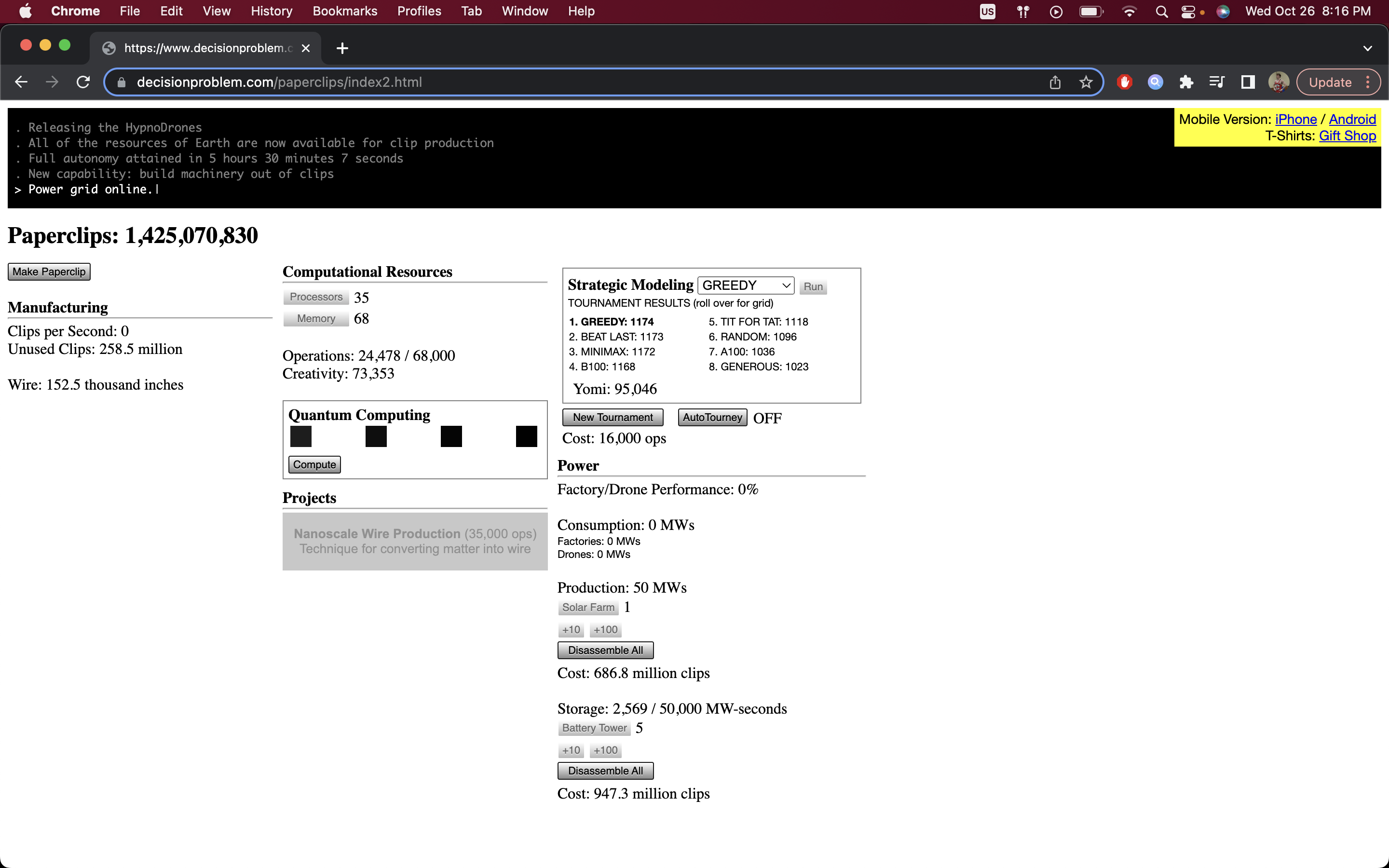
Expansion: After first learning of the hyperobject, being confused, and then becoming somewhat overwhelmed by the concept and what it might entail, I have been able to take some more time and consider it. The paperclip game, though theoretical and a fun little game, was an excellent example of a hyperobject. Following this post, I managed to reach well over 50 nonillion paperclips, and was subsequently forced to look outside of earth for materials to continue producing them. Though I knew it was just an imaginary situation, the idea that we have to look toward other planets for resources is utterly jaw-dropping, or at least it used to be. I would say energy is a prime example of a resource we may eventually have to search for away from earth. Fossil fuels are being used up at alarming rates to produce just about every single thing we use on a daily basis. One day, there will not be anywhere near enough to sustain the world’s population, and as such, if we don’t find a renewable energy source that has fewer drawbacks when it comes to its production and consumption than positives it comes with, I would certainly expect the hunt will continue on into the stars.
Unit 4 Moodle Post: Expanded
Unit 4: “Aesthetics of the Future”
Prompt: Finally, offer your own view. Where do you stand on the value or dangers of “critical fabulation”?
Response: I believe that, while undoubtedly a difficult task for one to do, it shines a light on those who never had their stories told. They underwent horrific experiences and had little to nothing told about them, meanwhile, a select few others, both from the time period being examined and others, have been celebrated and remembered for decades and even centuries.
Expansion: After further thinking, I maintain that critical fabulation has its uses, particularly for examining subjects in history such as slavery, where those victimized by it have no way of speaking out or having their stories told. That said, it is a practice I would say should require caution and consideration prior to beginning, especially as we can’t know if these people would have wanted this. From an outside perspective, one might argue that they never gain agency whatsoever, but rather have their stories told by someone who simply doesn’t have the full knowledge to, much less the authority, as man has no right to authority over other man.
Unit 5 Moodle Post: Expanded
Unit 5: “Ethics of the Future”
Prompt: Why do we think that we are a single continuous self? Why do we care about the notions of the self? What does it do for us? What would truly believing that there is no self involve?
Response: I am a continuous self because I have memories that span my entire life, though they vary in detail and length. To me, these flashes of memories serve as proof of existence in the past. Furthermore, I am able to have these memories corroborated by others who were there with me throughout them (family, friends, etc). Being able to believe in the “self” forces us to take responsibility for our lives and the decisions we make if that makes any sense. Our actions were made by our “executor”, i.e. our “self”, and actions have consequences, some good and others bad, depending on who they impact and what they are. Having a self gives each person personal agency and individuality; just as every human is unique in their genetic makeup, save for identical twins, a self is one’s identity. And though they share the same DNA, identical twins still have their own individual “selves”.
Expansion: Following the end of the Humanities-104 course, I still believe there is one “continuous” self. I do not believe that we have more than one individual being as we grow, and this is due to the memories we maintain and our general personality, temperament, and other traits which are verifiably determined or at least influenced heavily by genetics. That said, due to the potential for some of these to change, I am not opposed to the idea that the “self” can experience great change, but this does not inherently create a new entity.
