When it comes to the distinction between the Humanities and the humanities, there are several primary features that separate the two words and their meanings. These features, combined with their respective purposes within academics and understanding the world as a whole, are effective in laying out potential definitions for both the Humanities and the humanities. The capitalization of the ‘h’ causes a significant change to the meaning of the word, in a way I had never bothered to consider in the past.
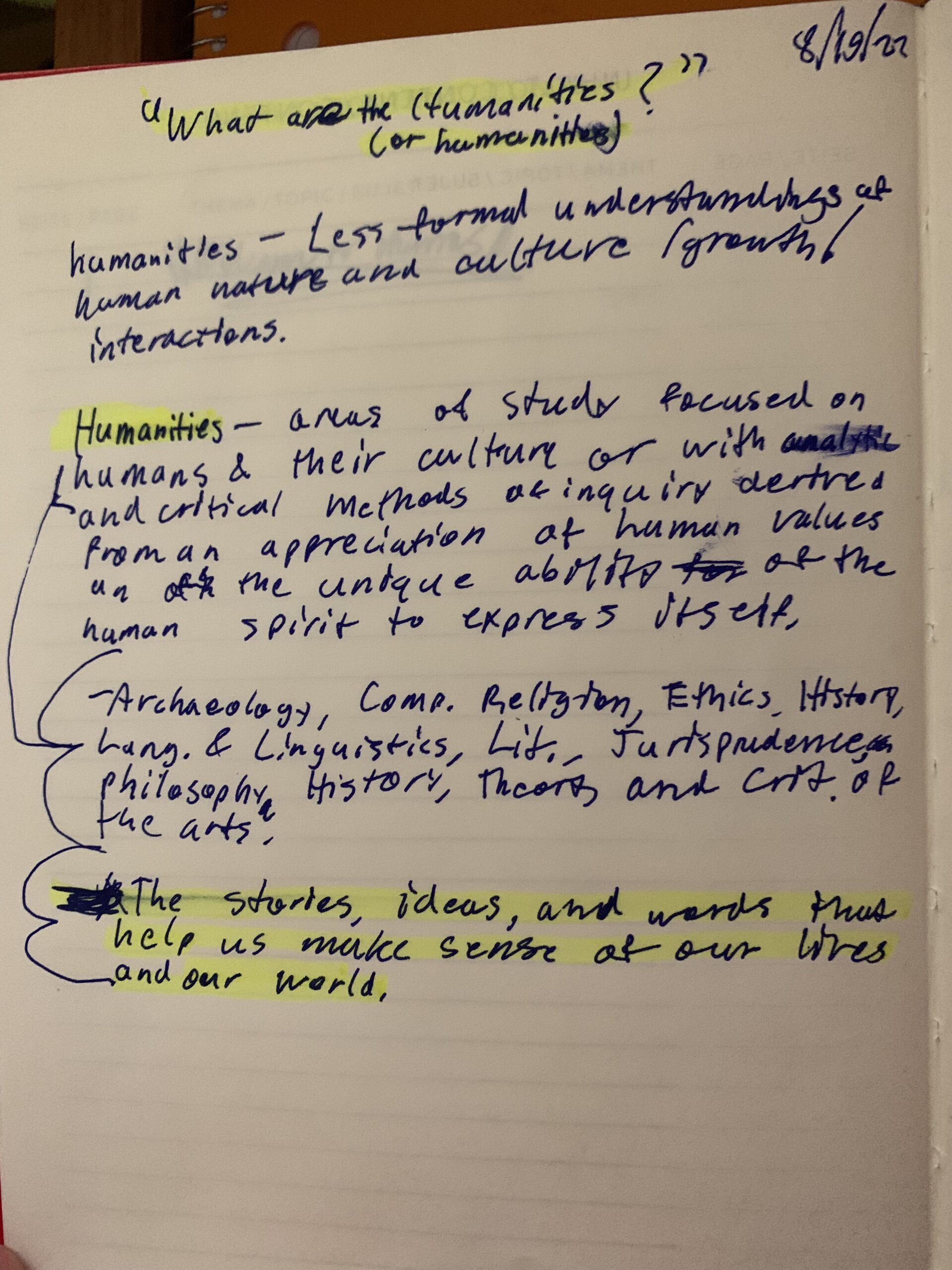
Prior to Sapere Aude and the Humanities-103 course, I had little to no understanding of the difference between these two words, let alone that there was one. I would see the capital ‘h’ in Humanities and assume it simply was a more formal method of referring to a set of academic disciplines, as one would capitalize the name of a course, for instance. The humanities, however, I saw purely as a means of speaking about humans and anything associated with them, though in general, this was with the thought of academics in mind. This notion was erased at once following our first discussion about Humanities-103 and my classmates and I were introduced to the fact that there is indeed a difference that exists between this capital ‘h’ and lowercase ‘h’.
To begin with, as we discussed “What are the Humanities” on day 1 of Sapere Aude, my belief that the Humanities were a set of academic disciplines was confirmed, with subjects such as Archaeology, History, Comparative Religion, Ethics, Philosophy, and others being within its contents. However, we learned that the humanities, while still revolving around the understanding of humans and our culture, was much less-formal than the study of a specific subject, unlike the Humanities. For example, were I to say I am studying the humanities, I might mean I am reading or learning about events that may have shaped human development or impacted culture(s), but I am not necessarily studying one specific subject. On the other hand, if I were taking a Humanities subject, I would a student of one of the various disciplines it stretches across.
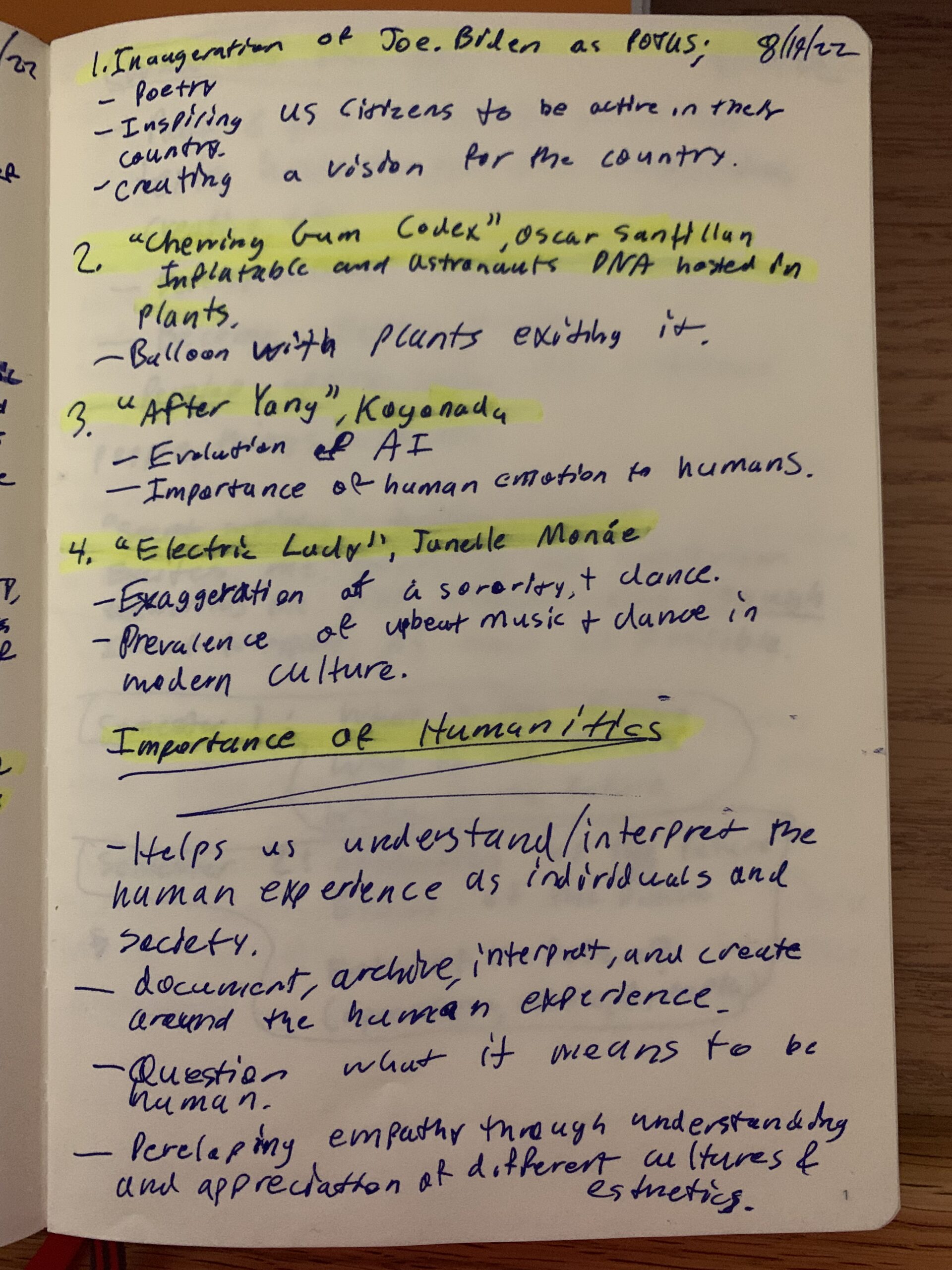
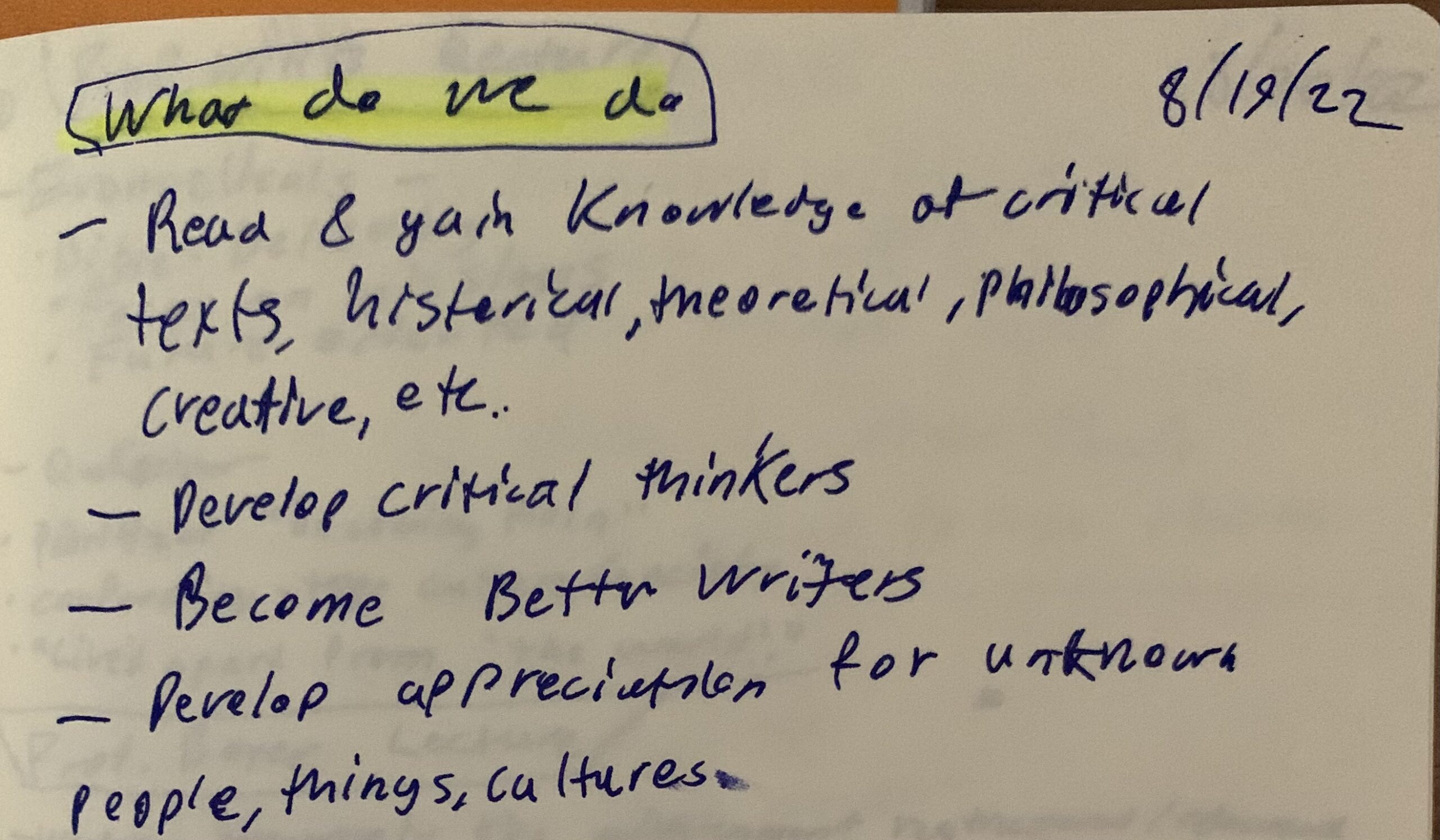
Another feature of these two words, or to be more specific, a feature of the “Humanities” is that it is more helpful in understanding and interpreting the human experience than the “humanities”. With Humanities studies, we can document, interpret, record, and continue to study and improve on the knowledge we have of humankind and all things associated with it (culture, civilization, language, history, understanding of why we exist, etc). Furthermore, the study of the Humanities enables one to improve their own empathy and understanding of unfamiliar cultures and peoples, as one studies various subjects focusing on aspects of the world that these terms encompass.
In Dr. Wiemer’s lecture during Unit 1, “What is the Future”, we discussed both the Epic of Sunjata, a poem that has been passed down for centuries through various means, and the topic of “what the past is (for)”. Such questions are examples of queries that may be answered in-depth through studying the Humanities, while a humanities approach would provide a more surface-level understanding. I believe that this understanding would revolve around the “who” and the “what” when it comes to discussing the passing down of a legendary story or the purpose of the past. Therefore, the humanities are less of an academic approach and more of a conversational one. The humanities may certainly lead to one focusing on an aspect of the Humanities, but they are overall separated by the degree to which they peer at various subjects pertaining to the world and the people and civilizations that have come and gone throughout time.
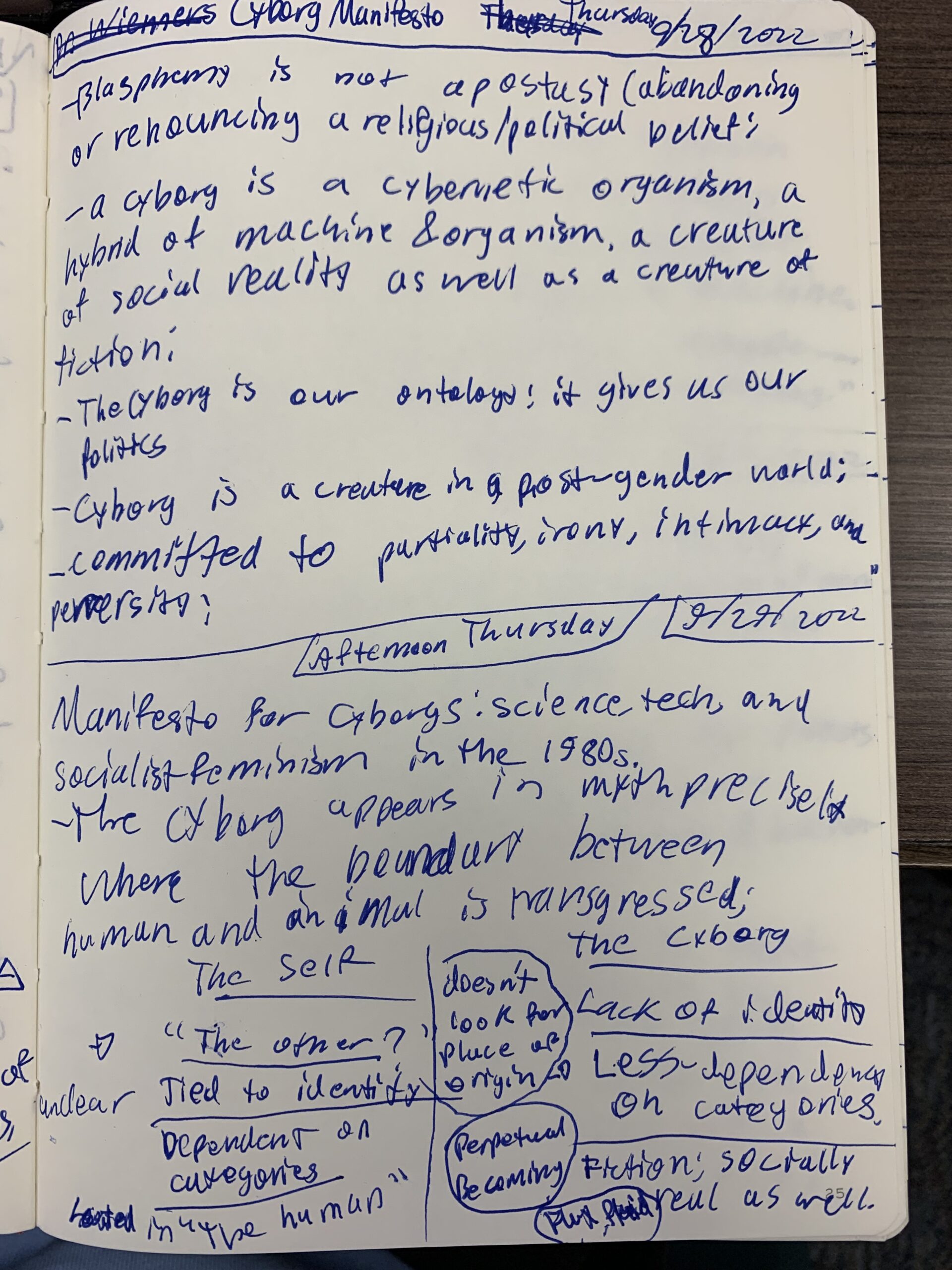
Discussing the concept of a “cyborg” in Unit 2, “Who is the Future” is an instance in which a humanities approach may be more beneficial than Humanities. The cyborg, being without a set “identity” and existing in a “post-gender world” is not a topic that anyone Humanities discipline might fully explain. While many may attempt to do so, the simple fact that it can be identity-less or have numerous identities makes it far more difficult to study through any lens of a purely-academic perspective. A more broad understanding would be necessary, one which looks at humanity and culture and civilization and all their respective developments, as is provided by the humanities.
In Unit 3, “When is the Future”, the discussion of Timothy Morton’s Hyperobject is undoubtedly a Humanities-type topic, one which the humanities simply would be unable to provide enough specification to even attempt to understand. The Hyperobject is something that spans many disciplines within the Humanities, and as such requires the understanding and study of such disciplines to grasp. The only thing a humanities approach to understanding the Hyperobject would do is perhaps partially reveal the scope of hyperobjects, rather than explain what they are or how they function. Through philosophy or literature, both Humanities subjects, one may better understand where hyperobjects are situated in our world. This idea, therefore, supports my belief that the humanities, though somewhat of a study of various aspects of the world, is less of a critical study and more of a broad glimpse of what is possible to be revealed by the Humanities, its formal and heavily academics-focused counterpart.
While there exists no exact or concrete definition for either the humanities or the Humanities, there are definite ‘clues’ to what both terms entail and how they are able to be used to understand the world around us, along with all its inhabitants, cultures, developments, and the interactions between them. As ironic as this is given the complexity of these words’ definitions, to put them in the simplest terms, the Humanities is specific in its usage for understanding the world around us, while the humanities is more of a sweeping overview and less of an academic perspective, though they both share the same general goal: learning about and interpreting the world and all it consists of.
With the knowledge acquired throughout Humanities-104, there are definite additions to be made to the definitions of both the Humanities and humanities, respectively. For starters, Unit 4, focusing on understanding the aesthetics of the future, examined various topics through a Humanistic lens, as well as the humanistic. One such topic was Africanfuturism, which can be examined Humanistically through traditional academic subjects, splitting apart its tenants of envisioning a future for the continent of Africa, spreading African culture throughout the diaspora, and its interaction with the cultures of others. Similarly, through the eyes of a humanistic perspective, these tenants understood and studied in a more broad manner, focusing less on Africanfuturism’s individual aspects on their own and more so on how it is interpreted and results in changes within society and the Black Diaspora.
When examining ethics, as we did in Unit 5 – “The Ethics of the Future,” a Humanistic approach would consist of studying the philosophies and ethics utilized by society. Studying them academically, identifying the characteristics that set each individual ideology apart from others, and looking at why and how society follows which rule, policy, or way of thinking. Through the lowercase humanities, however, society and the world would be analyzed with a focus on the effects of these ethics and philosophies. During this unit, the class watched Children of Men, utilizing both Humanistic and humanistic methods of picking it apart and understanding it. The movie, set in a dystopian world in which infertility is wreaking havoc on the human population, revolves around the ethics of reproduction. Humanistically, this movie could be viewed and understood for its involvement in academic ventures such as political science, ethics, sociology, philosophy, and literature. All of these academic disciplines might be used to explain the changes experienced in the society of Children of Men and to reveal the intricacies of the current human condition. On the other hand, a humanistic method of examining this movie would likely consist of analyzing the effects of the choices made by humans, collectively, and the point at which their society had reached.
Finally, the conclusion of the Humanities-104 was Unit 6 – “Ends of the Future.” Within this unit, ideas of what an end for the future would consist of, look like, or be caused by, were all discussed. Once again, the utilization of an academic approach, peering in-depth at the separate workings of these ideas would be capital “h” Humanities. For instance, if the “end of the future” was meant literally, meaning a willing end to the reproduction of the human race, this might be studied through sociology and political science, to understand why people, specifically those capable of giving birth, might no longer participate in this act. The Humanities approach would be ideal for understanding why this was occurring. However, given the sweeping overview nature of the humanities point of view, this would be ideal in examining the aftereffects of such a world state – one in which the human population is slowly, but surely, decreasing due to the choices of humankind.
Ultimately, these two areas of study, the Humanities, and the humanities are immensely difficult concepts to unpack and explain. This paper establishes working definitions for the two, however, ensuring it is known that, while separate, may be used together to fully understand what we have in our world. The Humanities, a formal academic approach to analyzing and seeing the world, is ideal for explaining and recording the who, what, why, and how of the human condition. The humanities, however, is ideal for meshing all of these together, looking at their aftermath, and viewing the resulting world, rather than focusing on individual aspects as single areas of study and not interwoven.